
There are many items one can add to an enamel. This page includes more information to supplement that which is in the book. Table of Contents
|
|
Lumiere Lusters (TM)These are embellishments not mentioned in my book. These beautiful flakes come in a wide variety of colors and were developed by Jet Age Studios and also sold by Cool Tools. They are fairly new product usable on a variety of medium and work great with enamels. They are micro thin sillica (glass) flakes that are coated on both sides with various minerals and metallic oxides, occasionally with some mica. They are similar to dichroic coating but not the same. Because of the way they are coated, they shimmer in more than one color. I can't get them to photograph well otherwise I'd show an image. |
|
Metal |
|
PaillonsI have found a catalogue of old Paillons from the G. Beyeler & Co. of Geneva, which closed in 1988. This is a .pdf file that you can download and save. These are not shown in the book, but I posted them here so you can see if your buttons with Paillons have ones manufactured by this company. I know the owl head I use is on page 16. Read about one company who enameled with Paillons. I show a button from them in my book - button #229 on page 59. See it here. |
|
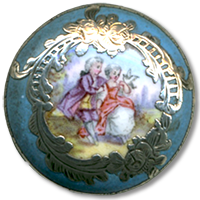
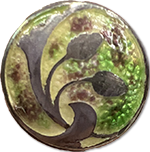
Silver Deposit/OverlaySilver Overlay is the name used when this electroplating process is done on glass or porcelain. It can also be done on enamel and in the NBS button world this is frequently called Silver Deposit (page 80), so as not to confuse it with overlay on glass, which is different. Some might call it Silver Resist, but that is a misnomer as discussed in the book. Anyway, these are hard to find and understand so I am giving a bit more information than what is in the book. In the process to form a Silver Deposit, a mixture has to be fired onto the enamel first. Just as in a Silver Deposit on porcelain or glass which needs a metal tab on the back of the button that attaches to the metal shank, so too you need a complete metal connection when done on enamel. This mixture has to be attached to the metal of the rim of the button as this rim is what is attached to the electroplating nodes (instead of the tab needed on glass or porcelain). This attachment allows for the current which is used in the process to extend to all parts to be electroplated. One thiing not mentioned in the book, the electroplated silver is then usually engraved to enhance the design. Sometimes this is even etched away (reverse electroplating) if the engraved design needs to have more depth. In terms of determining if something is a Silver Deposit or a Champlevé, one more characteristic than what the book describres is important to check... as the Silver Deposit is over the enamel, there has to be a slight lip to the metal where it attaches to the enamel. In the first button below, the silver frame is a) attached to the rim of the button and b) can be felt (ie: has a lip) to be above the enamel. The 2nd button which is a Basse Taille Champlevé enamel has a) the metal on the top attached to the rim, but b) is flush with the enamel (part of the process of Champlevé is when done enameling, the top is ground down to be flush with the metal). |
|
This is a medium button I bought at National 2024.
|
Basse Taille Champlevé button |
last updated
08/20/2025